



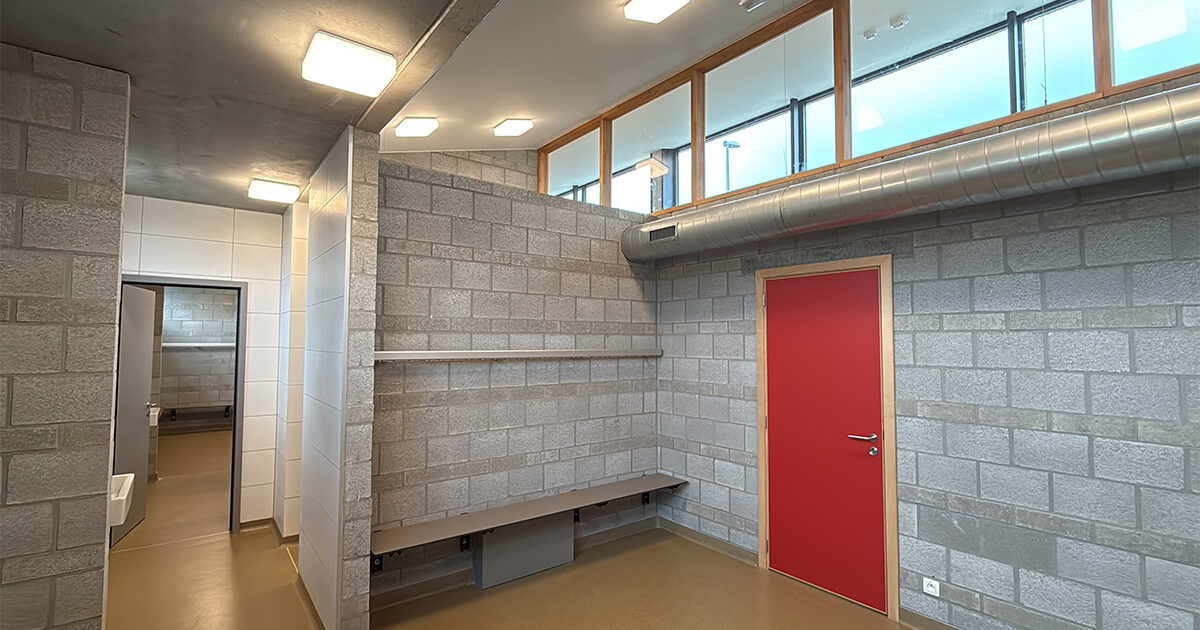
Cement-free building block is a Belgian global first. Carbon-negative revolution in construction
Masterbloc – Gubbels in Maasmechelen and Prefer in Flémalle are joining forces for the production of Carbstone: the world’s first 100 percent circular and CO2-negative building block. This Belgian innovation marks a true carbon-negative revolution in the construction sector.
Text | Jean van Pol Image | Masterbloc – Gubbels
The construction sector faces an immense challenge
Reducing the ecological footprint without compromising quality and performance. Concrete is traditionally one of the largest sources of CO₂ emissions, especially due to the use of cement, which accounts for approximately 7% of global emissions. Carbstone succeeds in radically reversing this trend. Thanks to an innovative production method, CO₂ is no longer emitted, but permanently captured within the stone itself.
How did Carbstone originate?
Carbstone originated from decades of experience in building block production, combined with groundbreaking research from Vito and innovative carbonation technology from partner Orbix. Later, the company joined forces with Prefer, and today the products are available through multiple distribution portfolios, supported by numerous certifications that attest to their leading quality.
Cement-free
The core of the innovation lies in the binder. Where conventional concrete uses cement, Carbstone utilizes carbonated limestone and residual materials from the metal industry, such as steel and blast furnace slag. During the production process, CO₂ is actively added. This CO₂ chemically reacts with the residual materials and is permanently captured within the material – a process known as controlled carbonation. As a result, not only does cement become redundant, but a stone is created that net absorbs more CO₂ than it emits. The result is a cement-free, 100 percent circular building block that is stronger than traditional concrete and also contributes to carbon-negative construction. Even during its service life, Carbstone continues to absorb CO₂, making the stone literally ‘greener’ over time. At the end of its lifecycle, the product can easily be ground into sand and gravel – fully reusable, without loss of quality.
Circular production
Carbstone exemplifies how circularity and performance can go hand in hand. The stones are produced from 10 percent secondary raw materials, without natural aggregates like sand or gravel. This not only reduces CO₂ emissions but also alleviates pressure on natural resources. What also distinguishes Carbstone is its extensive environmental accountability. While most environmental declarations (EPDs) only consider the production phase, Carbstone’s Sustainability Performance Declaration (SPD) encompasses the entire lifecycle: from raw material extraction and transport to use, demolition, and reuse. Each phase is optimized for minimal impact and maximum transparency. This full lifecycle approach yields something rare in the construction sector: total environmental transparency. Every phase is optimized, measured, and accounted for – proof that sustainability is not just a label, but a process.
Robust production capacity
With production sites in Maasmechelen (Masterbloc – Gubbels) and Flémalle (Prefer), Carbstone possesses a robust production capacity capable of serving the entire Belgian territory and surrounding markets. Carbstone proves that performance and our planet no longer have to be opposites. The stone combines structural strength, fire and frost resistance with a net negative CO₂ balance. Thus, it is not just a new building product, but concrete proof that the construction sector is capable of reinventing itself. In a time when circularity is no longer a choice but a necessity, Carbstone demonstrates that sustainability does not have to be a compromise – but an opportunity to build better, stronger, and smarter. Belgium can rightly be proud of this global first: a building block that literally lays the foundation for a low-carbon future.

Carbstone exemplifies how circularity and performance can go hand in hand.

Carbstone originated from decades of experience in building block production.

Carbstone combines structural strength, fire and frost resistance with a net negative CO2 balance.

Carbstone is a building block that literally lays the foundation for a low-carbon future.
Source: betonenstaalbouw.nl | November 11, 2025